
_edited.png)
The "Or Else" Clause: On Skill Checks and Saving Throws
- Helpful NPCs
- Dec 17, 2025
- 4 min read

I hate skill checks and love saving throws.
In the original Baldur's Gate, the first experience one likely has with skill checks is with Imoen, your thief girl-space-friend. In the ancient days, "skills" weren't a thing every class received, but were instead isolated to the thief class, so Imoen gets to Hide in Shadows and Set Traps and Open Locks. Unfortunately, she, like all level 1 D&D characters, isn't very good at this, so the player must needs mash the hotkey dozens of times until she successfully fades into the shadows (whereupon you can miss your backstab because your THAC0 is tied with the wizard's and get instagibbed by the game's chunky critical hit rules).
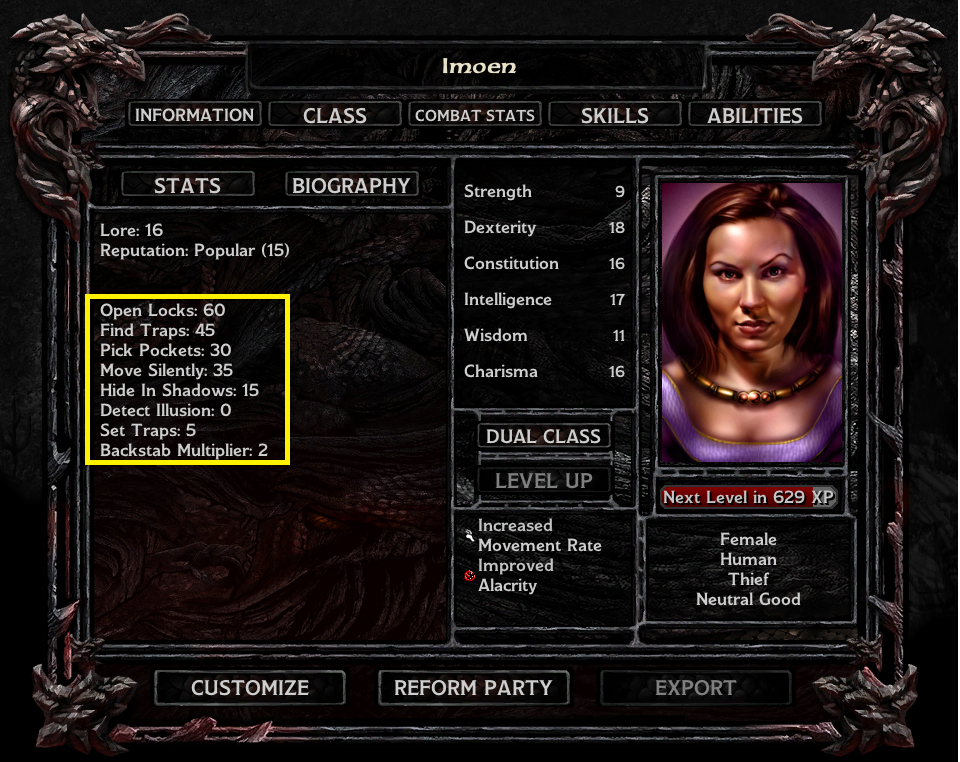
The hotkey mashing is the salient bit here because it describes how most GMs handle skill checks: mash the skill button whenever the skill might apply regardless of the situation and then, when the character fails, stand there dumbfounded as nothing happens and the player asks if he can try again.
Skill checks suck. As they're implemented in most RPGs, they stymie a character's competence rather than showcase it--and the most damnable part? They have the audacity to be boring while they do it.
Contrast that with saving throws. Saving throws are exciting because they have built-in danger: if you roll badly, something bad happens to you. When the GM says, "Make a saving throw," he's really saying, "Make a saving throw or else."
Spider bite? Make a saving throw or else you're poisoned.
Wizard's spell? Make a saving throw or else you're polymorphed.
Medusa's stare? Make a saving throw or else you're petrified.
Poisoned, polymorphed, petrified? That's what we in the business call alliteration.
It's a good system: simple, straightforward, and the players and GMs know there's something at stake.
The Solution: The "Or Else" Clause
My initial proposed solution is to abolish skill checks, which is met with a round of boos and a shower of rotten fruit.
Bah! Pearls before swine! Fine, we'll keep skill checks, but with one caveat: when the GM calls for a skill check, he must append the "Or Else" clause to it.
Make a skill check or else something consequential happens.
Haggling with the shopkeep? Make a skill check or else he gets the best of you and you pay 20% more for everything.
Searching the area for traps? Make a skill check or else you set one off.
Trying to discern whether someone is lying? Make a skill check or else he socks in you in the gob for side-eyeing him.
Okay, that one may be a little harsh based on how greatly I detest "lie detector" rolls, but the point still stands.
FAQs for GMs
Here are some frequently asked questions about the "Or Else" clause.
What if I can't think of a suitable "or else"? Don't call for a skill check.
What if the "or else" seems too harsh, punishing, or silly? Don't call for a skill check.
What if I don't think an "or else" makes sense? Don't call for a skill check.
You can adjust the "Or Else" for the theme and tone of your game. For instance, lighting your fireplace might call for a skill check or else you burn down your home in your cuh-RAZY Actual Play where you and your friends are trying to make a Critical Role knockoff but in reality annoy any would-be viewers. A more sober view of the "Or Else" clause might lead one to call for fewer skill checks because a superabundance of dice rolling is destructive to the game.
An Addendum: "Fail Forward"
If I were reading this article myself, I would immediately respond with something-something "fail forward," like "bro, fail forward already exists," or "bro, fail forward solved this years ago" or "bro, have you heard about our Lord and Savior fail forwar--"
Shut up. Just shut up. "Fail forward" is a buzzmeme that's tossed about thoughtlessly. Half the RPGsphere droolers misunderstand it to mean "success at a cost," which gets the grognards in a frothing rage about how snowflakes and their thirteen genders can't handle real gaming (they're not wrong), and the other half don't utilize it "failing forward" at the table unless they're playing a rules system that forces them to do so (PbtA).
What is the point of having a GMing tool that people don't understand or ignore?
We live in a world where Call of Cthulhu GMs are still forcing players to roll Spot Hidden to find plot-vital clues despite the 5e DMG literally saying quote-unquote ""[c]all for a D20 Test only if there's a chance of both success and failure and if there are meaningful consequences for failure." Think these aren't related? Oh, but they are. If the Fifth Edition of the World's Greatest-Or-Maybe-Just-Most-Popular Roleplaying Game instructs first-time GMs not to roll unless it's consequential while Call of Cthulhu GMs, who have moved beyond "the intro RPG" still can't get it right, it evidently doesn't matter how much you scream FAIL FORWARD because GMs won't use it.
The "Or Else" clause is a heuristic that attempts to resolve this. It's not an abstract GMing theory, it's a tool for use at the table that forces the GM to consider the weight of actions.


Comments